Panthera Tech, a team participating in the FIRST LEGO League (FLL), is a group of Glen Rock Middle Schoolers with unique thinking and compelling talents. The members include Aahana Saluja, Avika Saxena, Dia Mehta and Maya Harley. They started building their first Lego robot in September and qualified on Nov 22nd to participate at the NJ State level championship on Dec 14th. The team won the “Breakthrough Award” which helped them advance at the qualifiers. It celebrates a team that made progress in their confidence and capability in at least one of the core areas of FLL. Of the over 340 NJ teams that participated, only 80 teams (including Panthera Tech) advanced to the state championships, and only the top three teams were selected to represent NJ at a Nationwide FLL competition in Houston.
Scoring in FLL is divided into four areas: Robot Game, Robot Design, Innovation Project, and Core Values, which focus on teamwork and professionalism. Teams usually play three matches, trying to complete missions for points while avoiding penalties, like touching the robot at the wrong time. Each part is important for the overall score and team ranking. The team’s coaches include Head Coach: Varun Mehta, Assistant Coach: Shilpa Mehta, and Mentor: Tanvi Mehta (9th grade GRHS Cosmic Goose member).
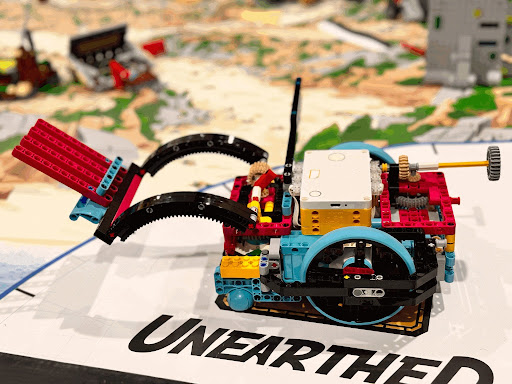
FLL is a form of robotics where legos are used to build the robot (see picture attached) along with different sensors and a central hub that has the code for the robot to perform 15 pre-programmed missions on a challenge board. The board layout changes every year along with the theme. This year’s theme is “Unearthed” and the missions and innovation projects are inspired by the challenges faced by archaeologists.
According to Avika, “basically what you have to do is you have to use a robot that you build with your team and you have to solve the missions using Lego block code and your robot which can be of any shape and size. It can have any amount of wheels, any amount of sensors as long as you are using the sensors from the kit.”
There are six sensors that work with the code to keep the robot on track to complete the mission. For example, the gyro sensor senses distance and there’s a color sensor which senses the line color that the robot is on because there are two to three lines on the board map and you can use those to position the robot and control its movements.
Another key part of the FLL Challenge is the Innovation Project, where teams pick a real-world problem related to the theme and design and present their solution to the FLL judges using posters or models. This team worked on an idea to help archaeologists, and others doing similar tasks, to do their field work more easily and comfortably by reducing pains and discomfort. For example, the team aimed to alleviate arthritis by designing a cast with interchangeable tools and an ergonomic hold to make work more comfortable. They got this idea after attending a virtual conference with senior professor Dr. Juliet Morrow, who teaches Archeology and Anthropology at Arkansas State University. She also mentors others in field work and research and also leads the Arkansas Archeological Survey.
The team worked for 3 to 4 hours every day, for the 2 weeks leading up to the qualifiers. They, of course, had breaks, and lots of bonding time. Of the many things that happened, the most funny scene had to be when they pledged to obey self-made rules and ended up breaking each rule within 5 minutes. Also, Coach Varun had many dad jokes that he often shares with the team, for example, “My daughter was cold, so I told her to go to the corner because it was 90 degrees”.
Speaking on why she joined, Dia said, “I had originally done OOTM (Odyssey Of The Mind), and wanted to try robotics. Our last mission on OOTM was vehicle, so I wanted to try something with robotics about building a car.”
Some special skills they had or developed involved code building, robot design, research and problem-solving. Maya said, “I learnt how to properly evaluate research and how to get work done, when you’re in a time crunch and how to properly code.”
Some of the challenges they faced were coding bugs and time pressure. “Getting the robot game missions finished properly and also making stable ideas for the innovation project,” Avika says. “Definitely code, when it goes wrong, it is hard to get it back and right. But once you get it, it feels good,” Aahana says.
The Coaches noticed the team’s growth, as they handled time pressure and overcame many obstacles in robot design and coding, especially since they had to complete multiple missions within 2 minutes and 30 seconds, including adjusting the robot attachments for each mission. The team’s mentor, Tanvi, helped the team practice their presentations on the Innovation Project and their Robot. The team is very thankful for all the guidance they got from their Coaches and Mentor, and excited to continue Robotics next year!
The Coaches are also working with Glen Rock Community School to bring this program to 4th through 8th graders, so a larger set of students can experience it and can represent Glen Rock at Robotics competitions. Also, having an initial understanding of robotics at the FLL level helps students transition confidently to the High School Robotics FIRST® Tech Challenge.